Solo Project
My Role
Timeline
Tools
User Research, User Experience, Visual Design
Jan - May 2025
Figma, ChatGPT, Excel
Twitch, 7TV
Providing Logic to Patterned Behavior
Digital Ethnography
What am I showing you?
This project is a digital ethnography of Supertf’s Twitch Chatroom, where I analyzed over 50,000 chat messages to identify behavioral patterns and understand how users express, perform and find their sense of belonging. I actively participated and took the time to understand the culture and community. Through user journey mapping, thematic categorization, and building a persona, I explored how cultural rituals and feedback loops shape user behavior. The findings were framed using theorists to further analyze and provide logic to the users behaviors.

Everyone has their own lingo...
Initial Discovery
As obsessively curious as I am, I tend to ask the question ‘Why?’ A little too often. When using social media platforms like YouTube or LinkedIn, I would notice a clear language shift between the mediums. That’s when I decided to look at more digital communities which led me to the extremely unique experience I found on Twitch.
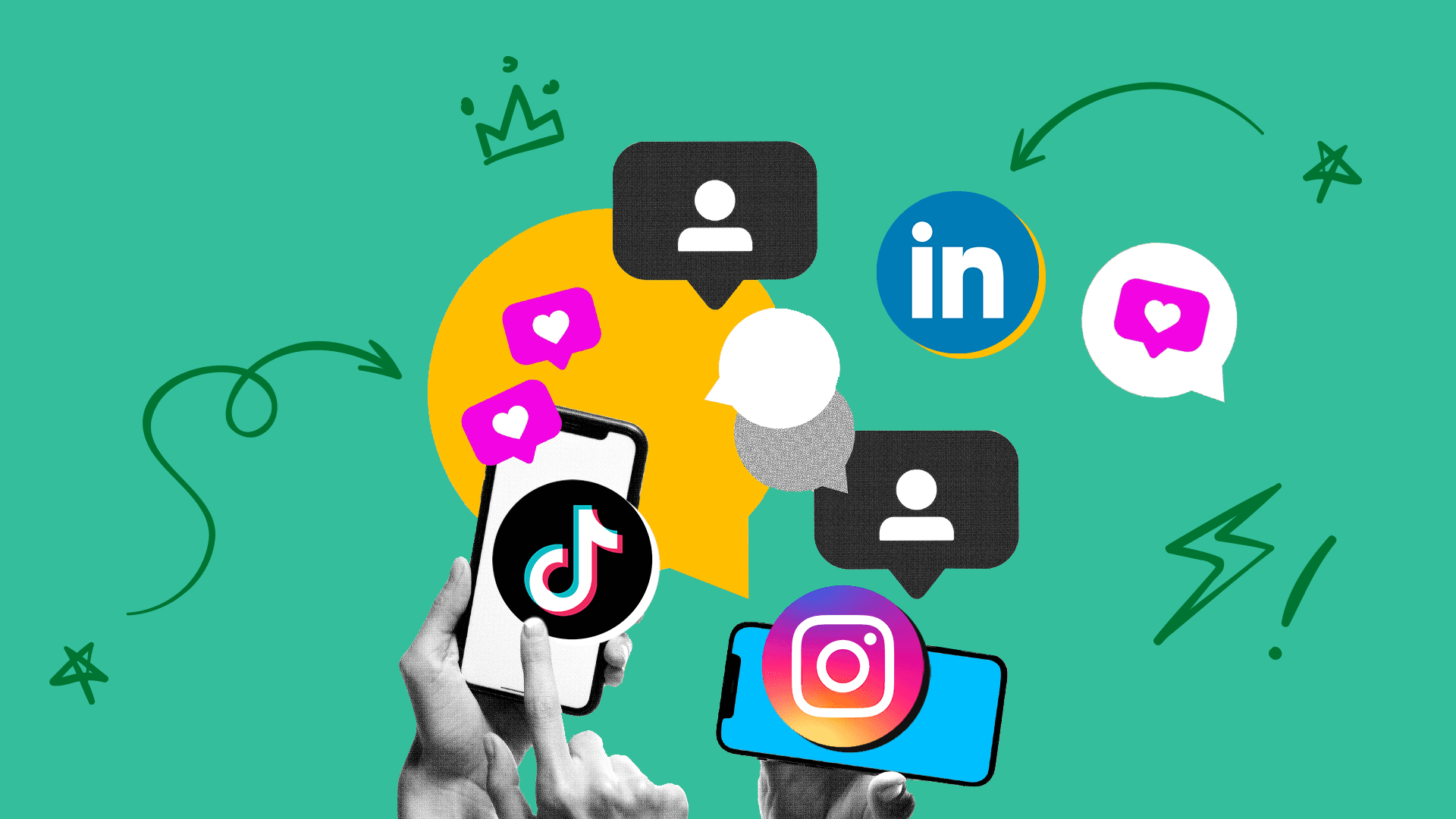
How does behavior in Twitch chat reflect broader patterns across digital communities and social media?
I answered the question
During my research of categorizing over 50,000 chat messages and mapping the Twitch viewer’s experience, I uncovered a system of patterned behavior shaped by feedback loops, platform design features, and rituals. The behaviors were often learned, repeated, and reinforced by crowd dynamics and the platform itself. To understand the bigger picture of the digital sphere, it’s necessary to provide logic to a smaller community in order to help identify the patterns and culture.
What Does the User go Through?
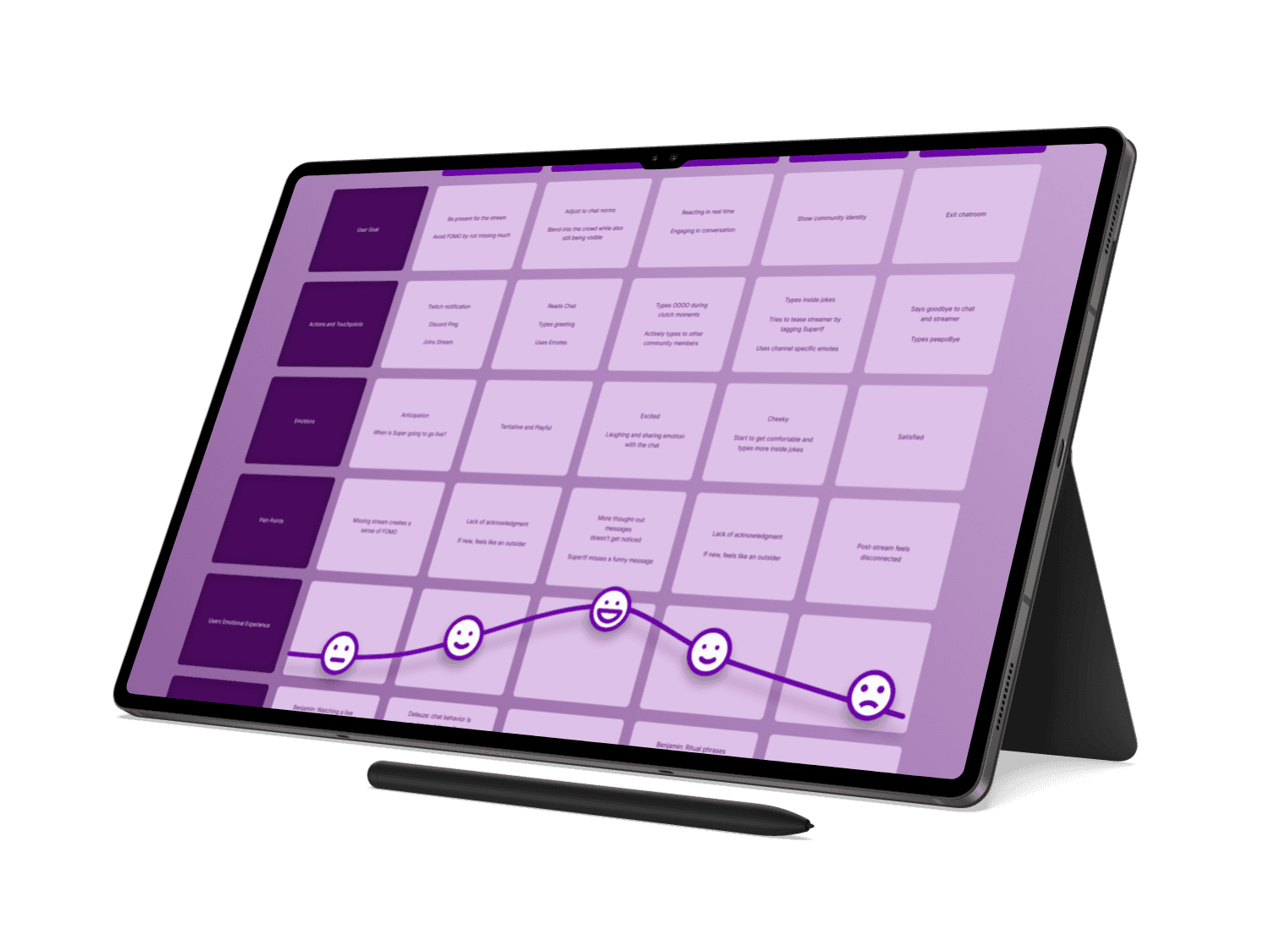
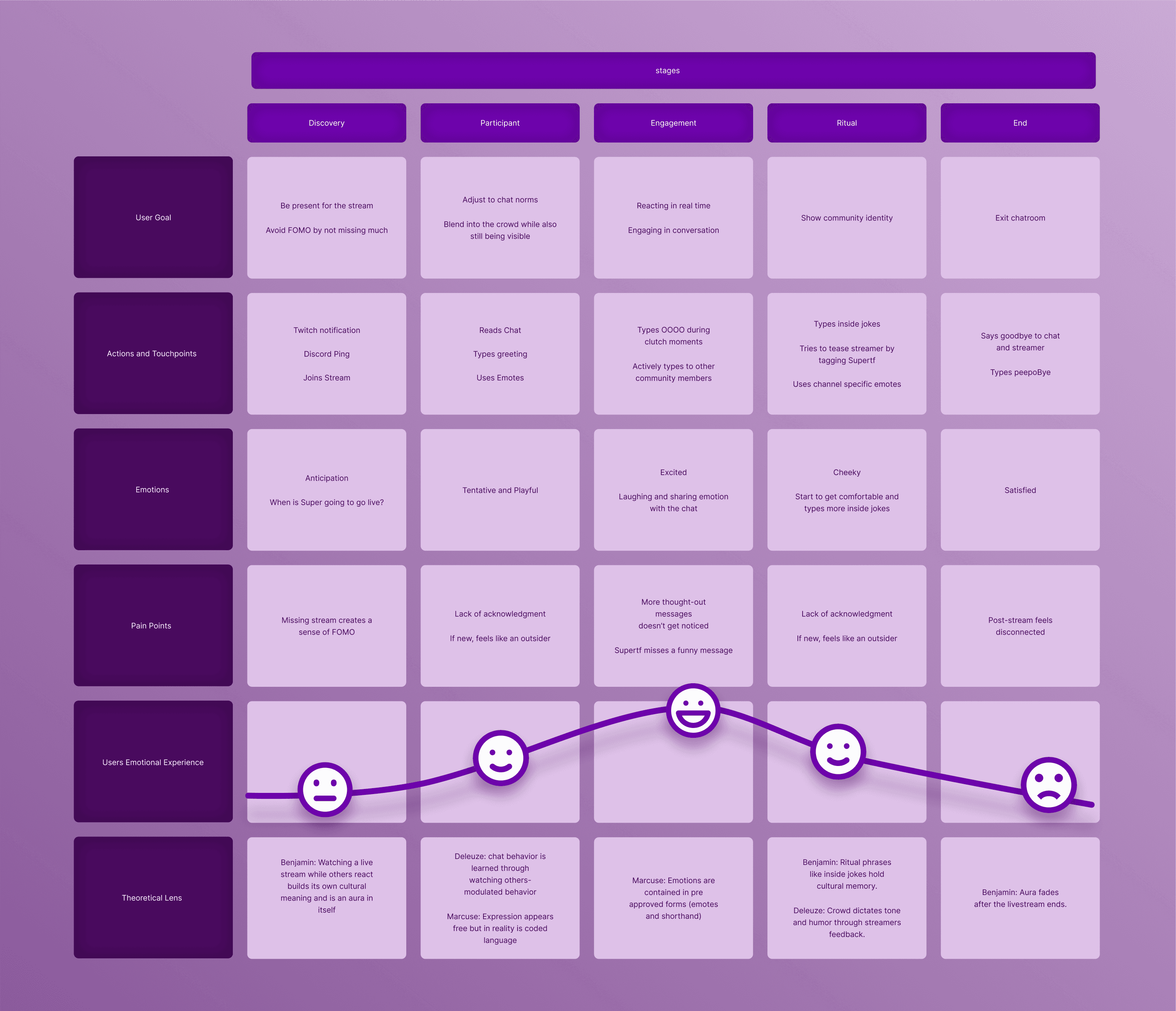
I created a User Journey Map based off my findings through analyzing chat messages, as an active participant, and talking to members in the community.
Who is the User?
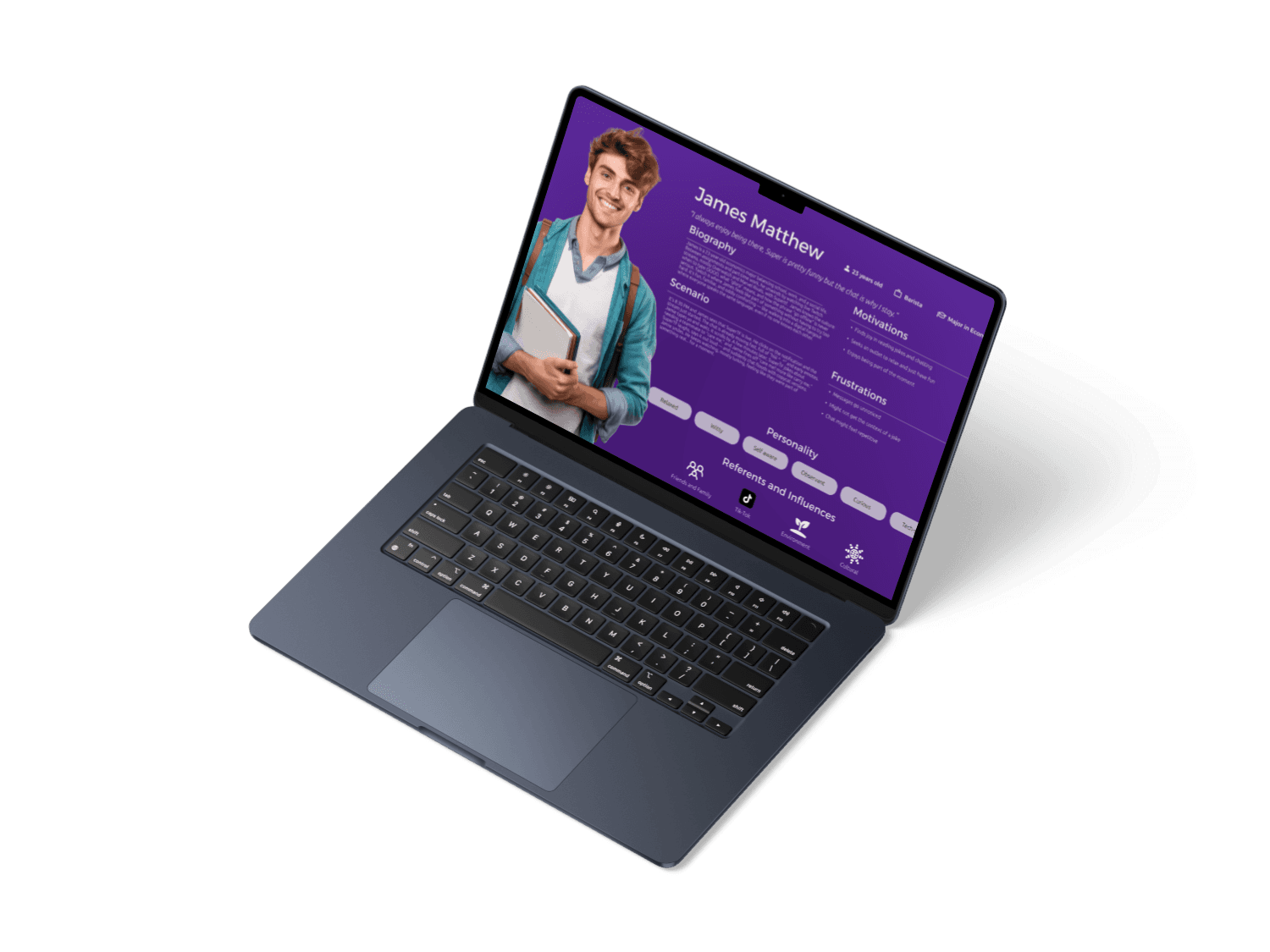
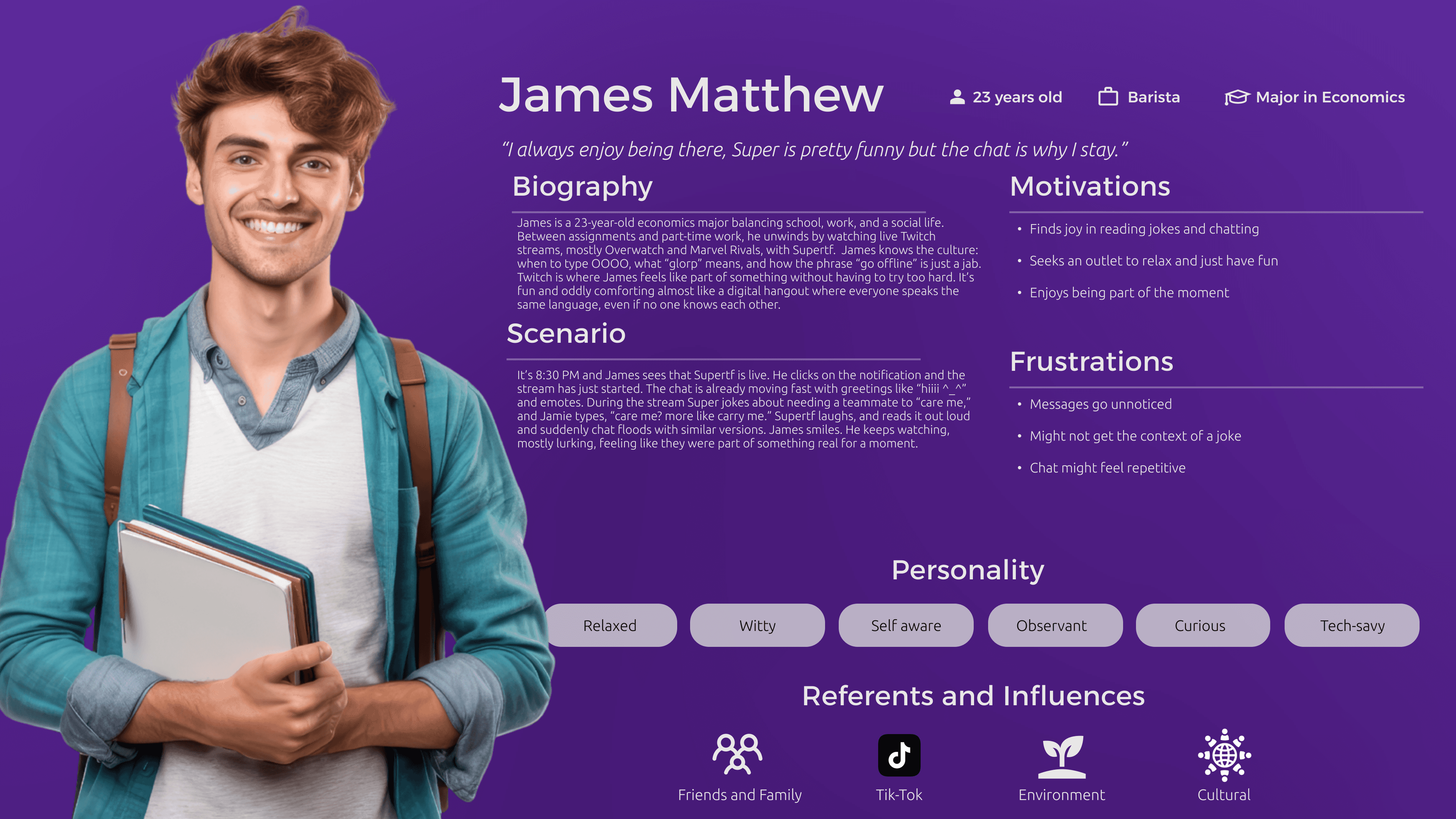
Understanding who uses the platform is a huge indicator on what other platforms they use, their language, and what their interests are. Based off the research data I collected and the analysis I did I created a persona.
01. Findings
How do we get the data?
“I’m starting to understanding what this community is like, I want to know more about what continues to bring them back and what their language actually is!”
Participation
I started to my research with a schedule, to watch a Twitch streamer of my choice with an active chat for 5 hours per week over 5 weeks. During this time I tasked myself to switch between actively chatting and silently observing. I took notes and played along with the chat.
I picked a few streams I was live for and exported the chatlogs into an Excel sheet. I then fed those (50,000+) logs to ChatGPT. Using this data I trained it to understand the Twitch logo and help categorize the data through ChatGPT’s natural learning process (NLP). I wanted to focus more on themes, tones, and context to better find patterns. I created categories with descriptions to help the AI label - in first attempts 12k messages were uncategorized and many were misclassified
By finding a solution I halved the number of uncategorized. I did this by further correcting the categorization by mixing in my observational data into the NLP and by increasing the emote detection through identifying all capitalized / camelCase messages in the uncategorized section.
Data Collection

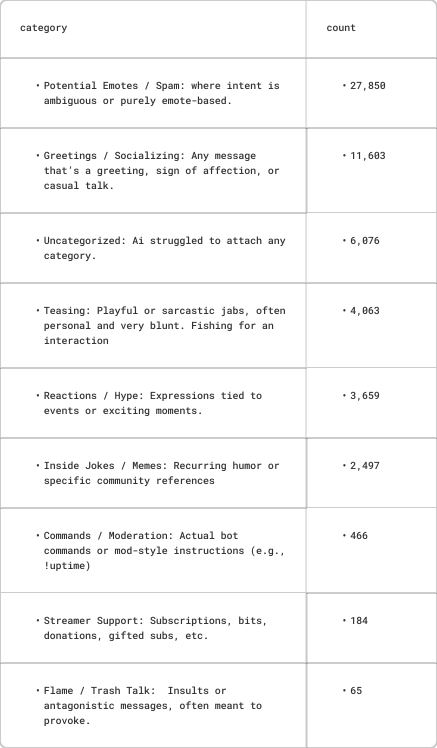
After gathering the results I created a table and provided the additional context, tone, and phrasing that I gave to the AI to help determine the category the chat belongs in.
02. Insights
What did the data we collect tell us?
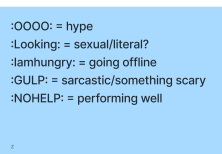
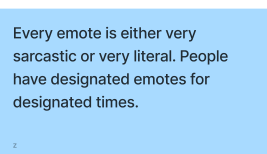
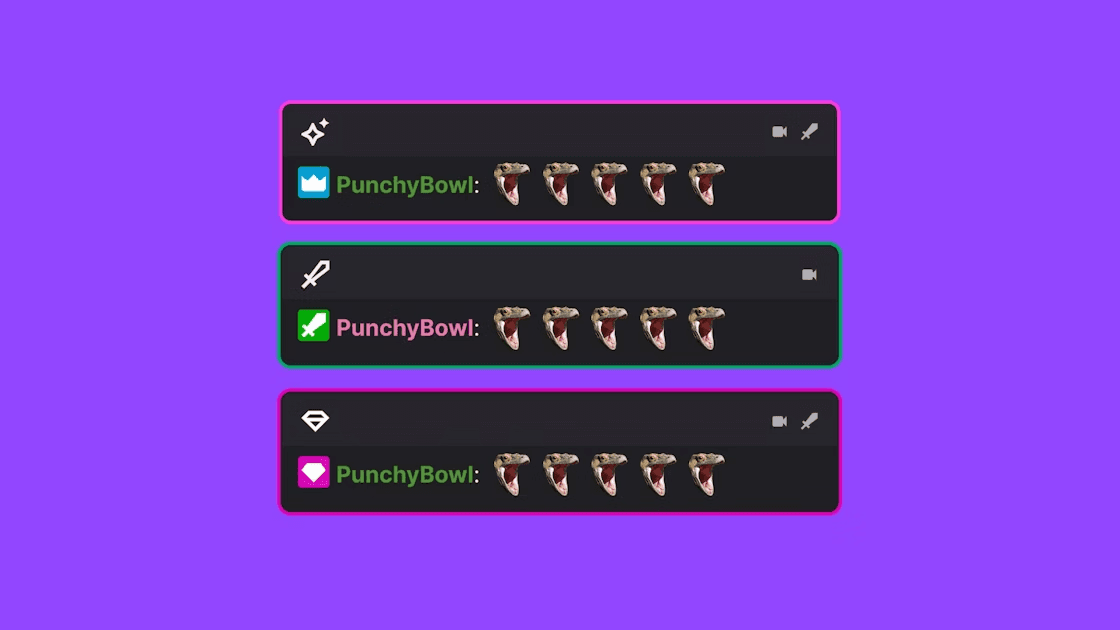
The chat is filled with a visually coded language - text that translates to pngs or gifs such as OMEGALUL , peepoBye , and hesRight form a nonverbal, effective vocabulary. You can gauge the emotion, and meaning of an emote almost instantly without having to read a single letter. Many of the emotes are used in Supertf’s chat as a way to mirror, mock, or elevate whatever is happening on stream.


The chat consistently greets and interacts to one another or Supertf, they can either talk about unrelated topics to the stream or they simply hold conversations within the chat by replying to each other directly.
Similarly the socializing can come from Supertf directly talking to his chat by asking questions. The chat has a very similar sense of humor formed through inside jokes, community members or within the chat itself. This sense of humor is adopted by the chat from the streamer and creates an in-group language that shared in the community.
Emotes (27,000+)
Socializing (11,000+), Teasing (4,000+), and Memes (2,500+)


I wanted to take this a step forward and tie in one of my fuels to my endless curiosity- philosophy and critical thinkers. I took some of their ideas and applied it to my findings, here are some of the concepts I wanted to use:
03. Exploration
What does the deep dive tell us?
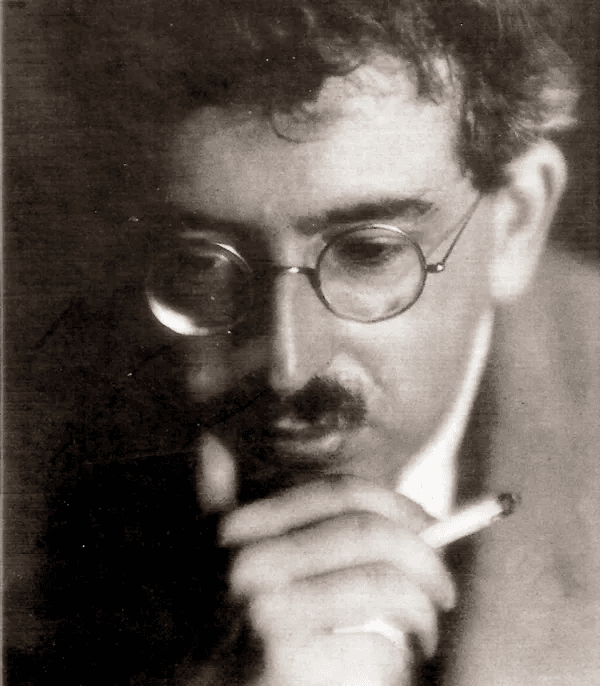
Aura is a concept coined by Benjamin to describe the singular presence of art tied to a moment in space and time. Meaning there is a special presence to it, giving it a heightened sense of value. During the mechanical age of reproduction, art was reproduced, reproduced at the rise of fascism. Reproduced as a propaganda, as soon as that art gets reproduced, the idea of that aura is gone.
Walter Benjamin’s “Aura”
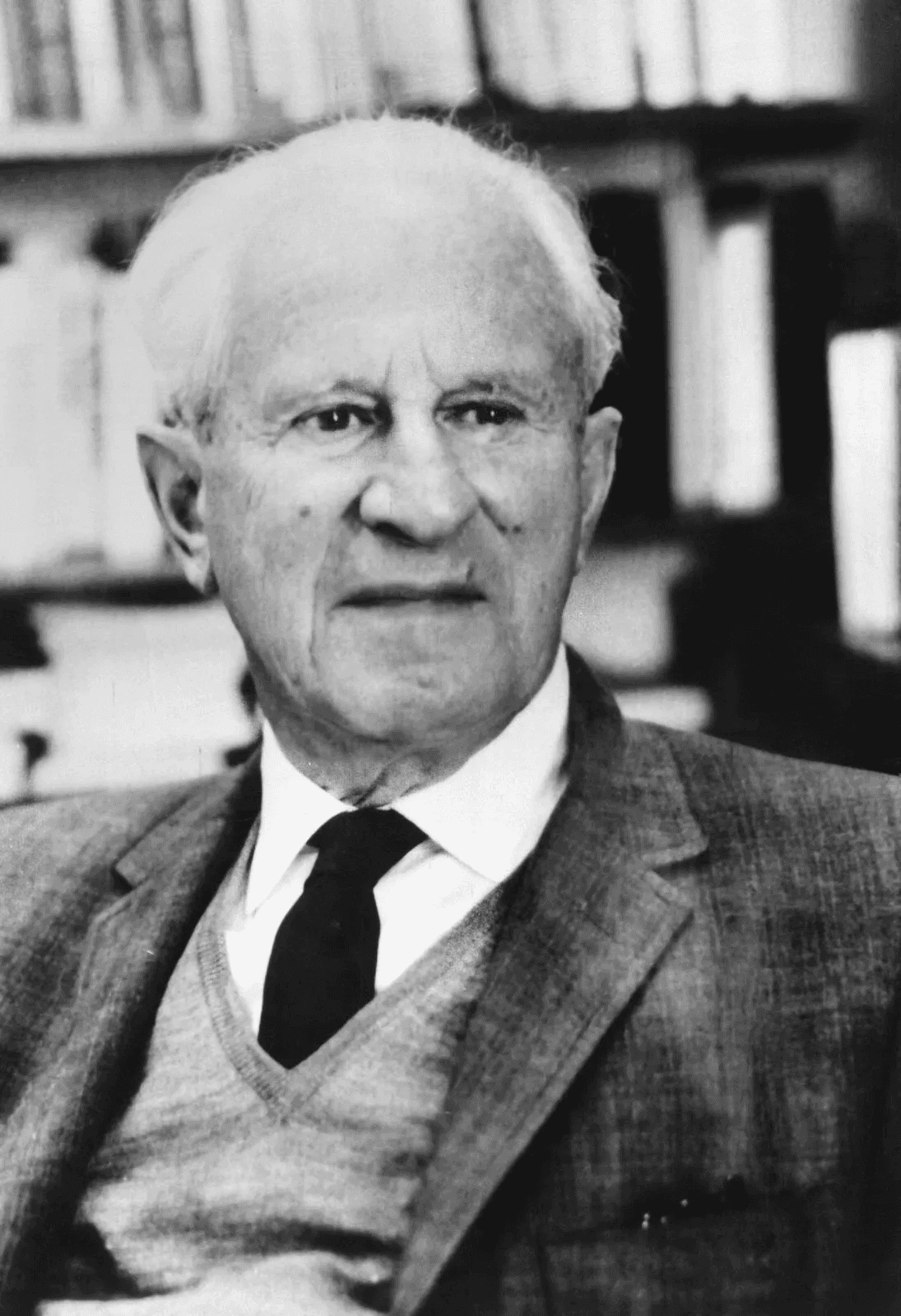
Sublimation is the act of sublimating a human desire into a manufactured one. In the context of capitalism, containing the energy of a 'false need' like channeling your creative energy into your work ethic to be more productive. Repressive Desublimation is the act of satisfying those needs but in ways that reinforce domination. When you're stressed and anxious becuase of your job you turn towards negative outlets. These outlets can be Netflix and Tiktok which arguably takes away critical thought and replaces it with passive consumption, and thus keeps us in a passive happiness.
Herbert Marcuse: One Dimensionality - Repressive Desublimation
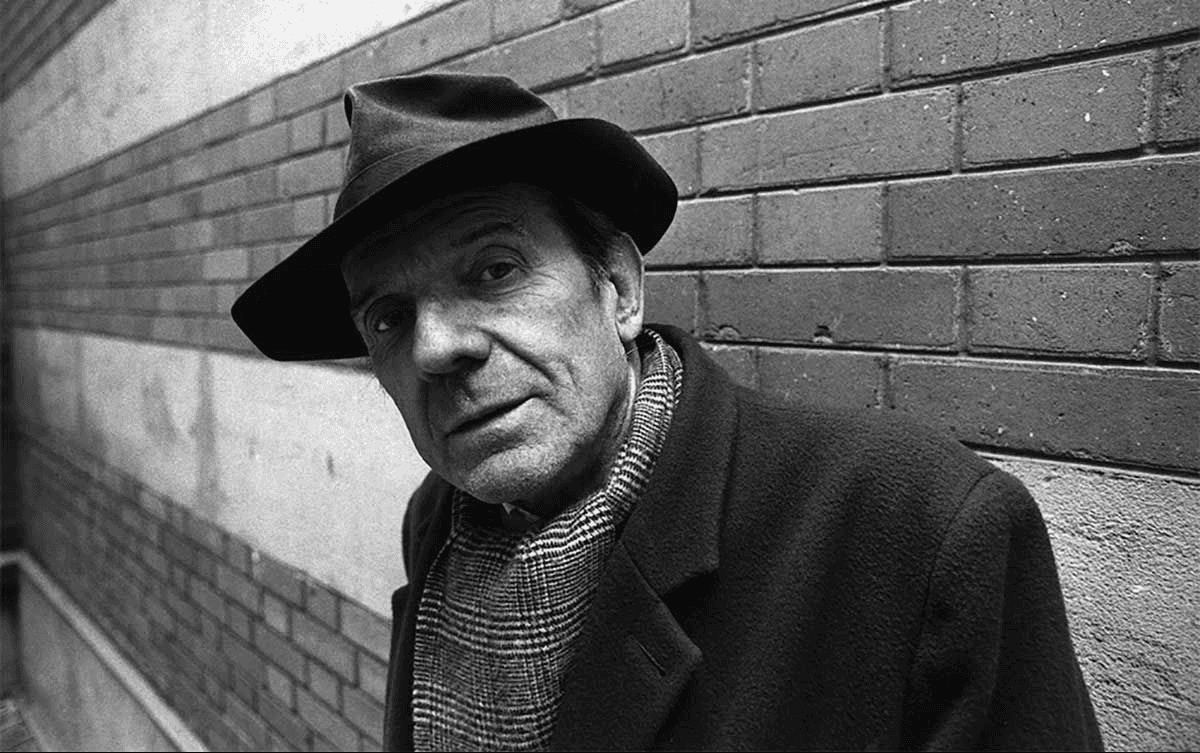
Deleuze argued that modern power does not control people through walls and rules like Michel Foucault once suggested, instead power works through modulation of choice and behaviors giving the impression of freedom while subtly shaping an individuals actions.
Gilles Deleuze “Control Socities”
While streaming on the internet forces the art to get reproduced, the event of watching it live with others becomes a singular aura itself. The aura here does not reside in the content in particular but in the experience of watching with hundreds or even thousands of users who are reacting at the same time together. Twitch chat becomes a social community that redefines aura for the digital age: viewers type emotes, recall memes, and perform platform and channel based rituals as a way of marking their presence. “OMEGALUL” and “GriddyGoose” are emotes and inside jokes that can only be found on Twitch, furthermore emotes that act like inside jokes like “WhitestManAlive”
are exclusive to Supertf’s channel. Competitive livestreaming platforms like YouTube contain their own sense of aura which is much less reliant on chat culture, creating for a much different experience.

Feelings of expressions like joy, or excitement are turned into a flattened a expression in the form of an emote to match the culture. Even critique of the streamer in forms of small phrases like “L streamer”. The chatroom almost acts as an instant gratification machine in itself where users release energy that is absorbed, then monetized, and finally normalized within the platform. In my personal engagement I felt this heavily as it almost acted as an outlet to be ignorant and only look to have a good time. Logging on almost daily, while funny, almost the same type of content and topic conversations are brought up, heavily focused on pop culture elements like games and sports.
Walter Benjamin’s “Aura”
Herbert Marcuse: One Dimensionality - Repressive Desublimation

The ways others greet each other, what the chatroom spams after a specific moment in the stream, these are soft constraints that put new users like myself in a position where it was extremely easy to catch on and therefore contribute to the stream system as it was. When something is funny in the chat it gets repeated and forces users to find their moments of spotlight but also creates for a lot of bad jokes that happen to get ignored. There is an inside joke where the chatroom makes fun of Supertf whenever he says ‘care me’, which sounds odd but it comes from the hero shooter games he plays (Marvel Rivals and Overwatch 2) where team play is a major part of that game and he needs his teammates attention as quickly and efficiently as possible. In this particular scenario after he says ‘care me’ multiple times someone in chat writes ‘care me, more like carry me’ which Supertf laughed at in signaling a positive reaction which caused an uproar of different variations, most of which were just annoying to read. These inside jokes to begin with are enforced within the community just by how often they are brought up almost every stream. The platform shapes expression through how your behavior is subtly steering into blending within the community, which is exactly what Deleuze argues.
Gilles Deleuze “Control Socities”
The Supertf chatroom is a dense cultural system which mirrors the current day digital landscape. We can see this through the condensed and compressed visual language seen in chat. They function like an emotional short hand. Emotes like :sadge: invokes a feeling almost immediately, this mirrors platforms like TikTok. Trends of how emojis are laid out in a specific way or brief phrases convey feelings quickly. These emoji trends (👁👄👁) and brief phrases (“real”,“ahh”) convey mood or humor without full sentences. Both spaces value speed, recognizability, and alignment over complex thought out thinking.
Similar to how I discovered what was right and wrong to post in the Supertf chatroom, social media platforms like X, Tiktok, and Instagram, users fall into a feedback loop on what is good to post for the algorithm vs what might not work. Deleuze’s ideas of modulation of how power just needs to suggest shows how users in social media platforms shape visibility.
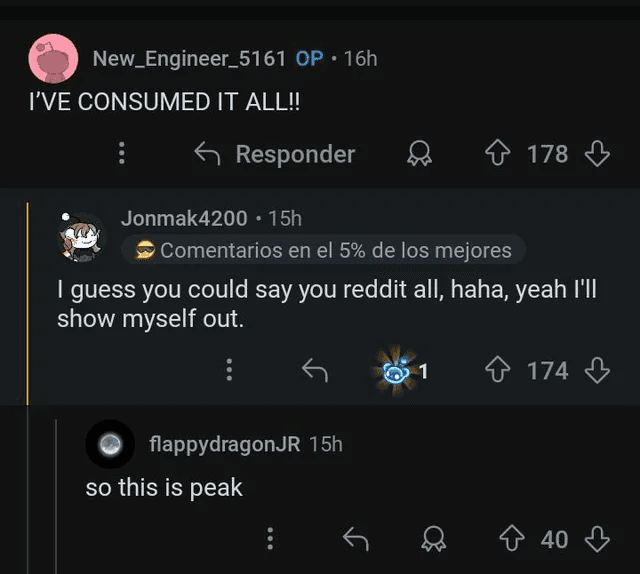
Platforms like Reddit share a similar sense of vocabulary or the notion of recycled phrases becoming shorthand and resulting in a sense of belonging. Reddit language using things like “OP delivers” or “You sir or ma’am, have won the internet today” are rituals that reinforce that shared history of being on that distinct platform.
04. Validation
What can we apply this to?



What I found about what makes Supertf’s chatroom special is how naturally it reveals the internal architecture of digital behavior through its systems at play. Language systems though emotes, memes, and shorthand. Cultural systems through inside jokes, and collective rituals. Social systems through that feedback loop of what is good to say and what is not. And technological systems through algorithms, moderations tools, and platform design.
My ethnographic work has showcased a pattern of behavior and provided logic alongside it. I showed how expression is modulated through soft control, how expression is turned into containment in the form of play, and how presence is reshaped through a shared experience. I’ve shown that digital culture doesn’t just happen but instead it’s built and enforced by the community, the platform, and the moment. Platforms like Twitch produce communities, communities like Suptertf’s chatroom. What emerges in these small, live moments reveals how people make meaning together in live spaces.
And that matters - not just for theory but for how we design for the next generation of digital environments.
05. Impact
So What?
Based off my research and analysis I created a persona and an interactive user journey map. These tools were created as a summary to my case study highlighting what I learned, click on the image to see the full prototype.
Based off my research and analysis I created a persona and an interactive user journey map. These tools were created as a summary to my case study highlighting what I learned, click on the image to see the full prototype.
A user journey map is a visual tool that outlines the key moments, actions, goals, emotions, and pain points a user experiences as they interact with a product, service, or in this case a digital space. It helps researchers and designers empathize with the user’s perspective by breaking down their experience into different phases. In my project, the journey map captures the relationship a Twitch user has with a live chatroom from discovering and turning on the stream to becoming a regular participant and eventually forming rituals and expectations. It reveals how behavior is shaped by community norms, the platforms design, and cultural feedback loops.